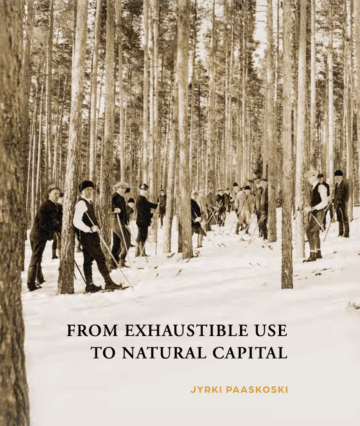
In 2025, Finsilva published a historical study exploring the eventful past of both the forests owned by Finsilva and their owners.
Written for a Finnish audience, this 320-page work examines how these forests have changed over the long term, driven by natural processes and the requirements of society, as well as the individuals and companies that have owned and utilised them. With a more concise English-language volume, From Exhaustible Use to Natural Capital – The Story of Finsilva’s Forests, Finsilva aims to engage in the global forest discussion and delineate the distinctive features of Finnish forest nature, alongside forest use and management, for the company’s international partners worldwide.
The book seeks to enhance understanding of the human-forest relationship, tracing its evolution and the consequences of these changes from the distant past to the present day. It explores the various purposes for which humans have relied upon the forest, the ways in which it has been utilised, and the traces this usage has left behind across different eras. Furthermore, it examines the unique history of Finsilva’s forests, documenting their various owners and numerous users throughout the course of time.
Established in 2005, the Finnish forest and natural capital company Finsilva Plc is a young enterprise, yet the forests it owns have regenerated countless times over millennia. The saying “forest ownership changes, but the forests are eternal” captures a fundamental truth regarding the divergent timescales of the individual, society, and the forest. The human lifespan is shorter than that of society, yet both are significantly shorter than the deep time of the forests.
The forest has served as a resource that humans have utilised in numerous ways. While remaining relatively small until the 18th century, Finland’s population left clearly visible traces of slash-and-burn cultivation, tar burning, forest grazing, as well as the extraction of firewood and other timber for household needs throughout the southern part of the country. For a long period, slash-and-burn cultivation was the predominant form of forest use, and the proximity to navigable waterways gave rise to tar production and the sawing of planks. The ironworks of southern Finland relied on charcoal-powered industrial processes, which led to the localised exhaustion of forest resources in some areas. However, the majority of timber was consumed in the hearths of draughty dwellings or used for fencing, construction, and other domestic necessities.
The emergence of steam sawmills and the rise of the pulp and paper industry towards the end of the 19th century heightened the pressure placed on the forest. Yet, as recently as the early 20th century, industrial timber consumption accounted for only one-third of the total volume consumed by the Finnish population for fuel, construction, and household needs.
The primary challenge of forest use in 19th-century Finland was the lack of reforestation. Felling and slash-and-burn sites were largely left to regenerate naturally. Livestock grazing in the forest trampled emerging saplings and browsed their leading shoots. Furthermore, the practice of high grading—felling only the finest specimens—left behind weaker trees that were incapable of vigorous growth. Undergrowth struggled for light, and seedlings were often smothered by encroaching grasses. It was only with the advent of modern silvicultural science from the late 19th century that systematic forest regeneration and management were finally mastered.
Forest ownership had a direct impact on the use and, consequently, the condition of the forest. The Great Partition, which commenced in the latter half of the 18th century, along with the Act of Union and Security issued by King Gustav III in 1789, established the foundation for private forest ownership. The majority of Finsilva’s forest holdings—approximately 130,000 hectares—originated from lands previously owned by the Finnish companies G. A. Serlachius, Ab J. W. Enqvist, and Metsäliitto. For these enterprises, forests were a resource managed according to specific long-term plans. Annual harvests were assigned a maximum limit to ensure they did not exceed the annual growth per hectare. Forest regeneration, achieved through either sowing or planting seedlings, along with timely clearing and thinning, was essential to ensure vigorous growth. It was economically prudent to take excellent care of these forest assets.
In response to climate change and declining biodiversity, the human-forest relationship is undergoing a transformation. One example of this shift is the concept of natural capital, which refers to the value of all resources derived from nature, including soil, air, water, and living organisms. Efforts to strengthen biodiversity and the creation of supporting economic incentives are prime examples of the emerging markets generated by the concept of natural capital.