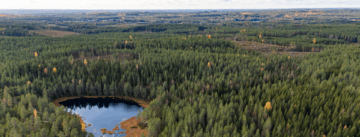
Forest and natural capital company Finsilva’s biodiversity measures demonstrate that nature values can be strengthened as part of profitable and sustainable forestry. From the perspective of owners and investors, this represents a long-term approach to building forest value in a changing operating environment.
In 2025, Finsilva introduced a significant number of structural features important for biodiversity in its forests: more than 100,000 retention trees, over 90,000 high biodiversity stumps and more than 6,000 protected thickets. In addition, the company restored seven natural sites, carried out controlled burning and restoration burning of retention tree groups across a total of 37 hectares, and permanently protected more than 64 hectares of peatland.
“Through its biodiversity efforts, Finsilva is setting the standard not only in Finland but across Europe. Owners and investors increasingly see this as an essential part of the company’s ability to generate added value,” says Sami Veijalainen, Chair of the Board of Finsilva.
In Finsilva’s commercial forests, structural features important for biodiversity are added in connection with forest operations to a significantly greater extent than in average Finnish forest management.
“Our way of operating enables us to enhance biodiversity and generate nature values systematically and over the long term as part of profitable forestry. Through the market, we receive compensation for the nature values we produce,” says Juha Hakkarainen, CEO of Finsilva.
Biodiversity in harvesting and young stand management
According to a study conducted by the Natural Resources Institute Finland (Luke), the Finsilva model significantly increases structural features important for biodiversity in commercial forests. Over a 50-year time horizon, this is reflected, for example, in a more diverse range of species.
“The volumes of structural features are in line with the previous year, which shows that we are continuing along the path outlined in Luke’s scenario analysis. Naturally, the figures vary from year to year depending on the scale of harvesting and the types of sites undergoing treatment. This year, particular attention is drawn to the exceptionally high number of high biodiversity stumps,” says Markus Nissinen, Forest and Environmental Manager at Finsilva.
Retention trees were left in Finsilva’s forests in 2025 at an average of 18 per hectare across the treated area. In total, approximately 98,000 living retention trees and around 8,000 dead retention trees were left standing in connection with harvesting.

High biodiversity stumps were made in 2025 at an average of 15 per hectare, totalling just over 90,000.

Protective and game thickets were retained in connection with young stand management and preliminary clearing, with a total of approximately 6,000 left in the forests.

Biodiversity was also enhanced outside commercial forests
Alongside biodiversity measures carried out in connection with the management of commercial forests, Finsilva maintains and enhances forest biodiversity in sites that fall outside commercial forestry.
“In modern forestry, all available tools for safeguarding biodiversity must be put to use. We are also continuously seeking new tools, as we are currently doing in a pilot for nature values trading with S Group,” says Nissinen, referring to a peatland restoration project in Pielavesi.
Natural sites were restored on Finsilva’s land in 2025, with a total of seven projects completed. Of these, three involved peatlands and four focused on watercourse restoration.
Protected areas were established in two locations, covering a total of more than 64 hectares. Both sites are part of the Helmi programme and have been permanently excluded from forestry and other active land use.
Controlled burning and the burning of retention tree groups were carried out across a total area of 37 hectares. Controlled burning accounted for nearly 30 hectares, and 14 retention tree group burnings were conducted. The average size of the burned tree groups was approximately half a hectare.
For more information and interview requests:
Juha Hakkarainen
CEO, Finsilva
juha.hakkarainen[a]finsilva.fi
+358 40 087 0867
Markus Nissinen
Forest and Environmental Manager, Finsilva
markus.nissinen[a]finsilva.fi
+358 40 573 1131